
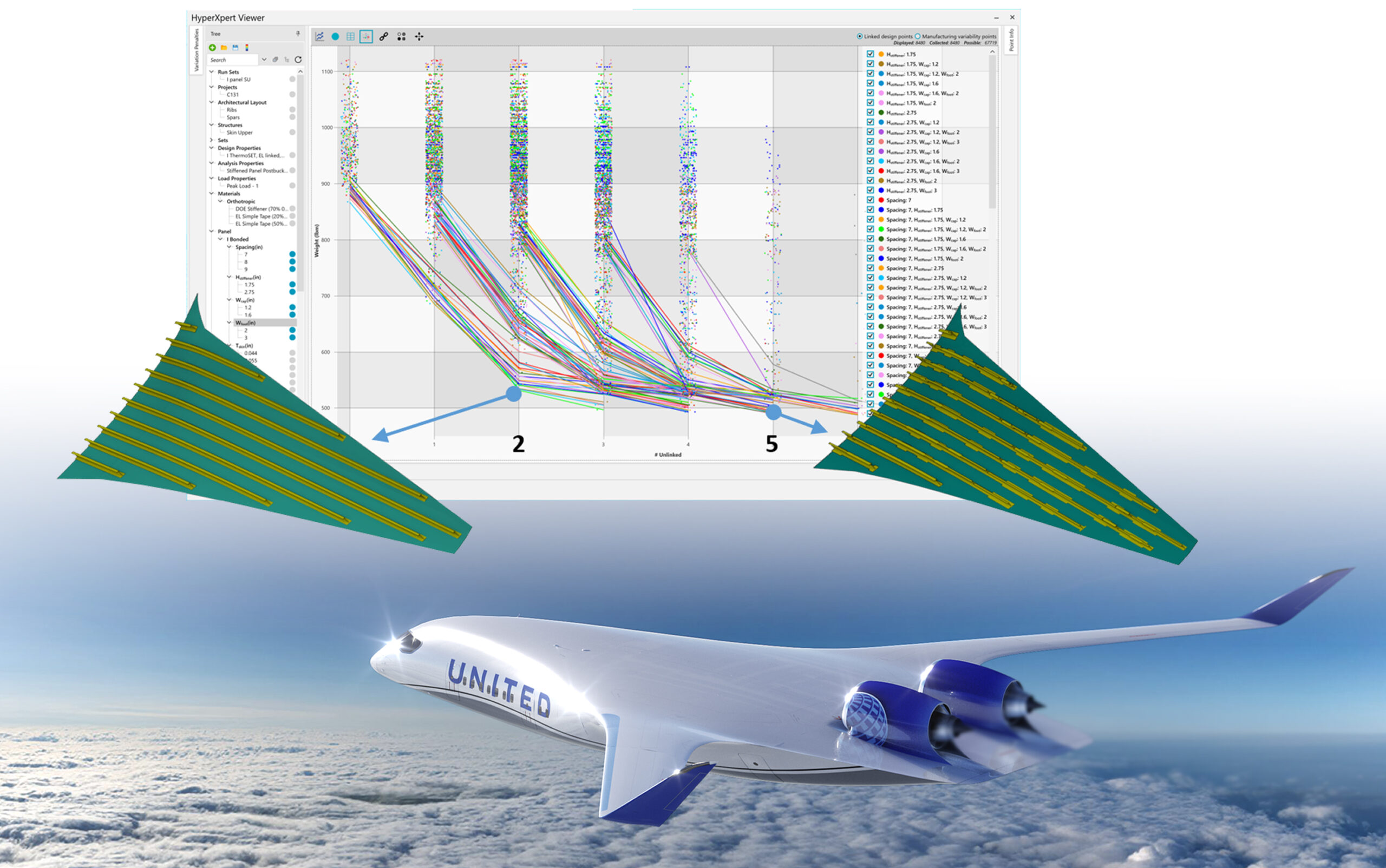
HyperXpert is an interactive tool enabling early evaluation of new airframe designs, like JetZero’s blended wing body Z4, for lightest weight and producibility. Operating within HyperX, it enables data-driven decisions and collaboration between design, stress, manufacturing and management, speeding maturation of the best design, including manufacturability, to shorten design and certification timelines. CREDIT: Collier Aerospace and JetZero
June 22, 2026
Written by Ginger Gardiner
Automating aerostructure optimization for lightweight and manufacturability
HyperXpert is an interactive, visual tool that optimizes all possible combinations of design variables simultaneously and sorts them with respect to producibility, cutting schedule and cost for next-gen airframes.
Aerospace has entered a new era where not only the number of airframes is unprecedented but so is the pace of development. Aircraft like JetZero’s blended wing body (BWB) Z4 and Otto Aerospace’s elliptical laminar flow fuselage for the Phantom 3500 haven’t gone into production before. “The loads are different, the issues are different, and so are the hot spots,” notes Craig Collier, CEO and President of Collier Aerospace. “And yet, the engineers in these companies need to mature the best design quickly, essentially compressing into a few years what previously would have evolved over decades. They need tools to explore the design space and fully consider all the different ways that you could possibly make the airframe lighter, but also manufacturable, which directly impacts cost and schedule.”
Collier Aerospace understands this problem, having matured its suite of CAE software over the past 30 years into what is now HyperX, a product that automates stress analysis to perform structural sizing, lightweighting and margin of safety calculations for composite and metallic structures. Its ability to shorten design and certification timelines has been demonstrated repeatedly by companies like Bell Helicopter, Boeing, Lockheed Martin, GKN, Archer, Blue Origin and many more.
But now the company has introduced HyperXpert, an extension to the HyperX workflow that not only identifies thousands of very good lightweight designs, but with a click in a checkbox, goes further, evaluating those designs for manufacturability. “Maybe you have tooling already available or a certain kind of laminate family that you’ve used in the past,” says Collier. “From thousands of equally lightweight designs, you’re now able to decide which of those optimum designs are best for the way that your company produces parts, but in real time. You simply select the variables and trend lines you want to explore and it shows you those results immediately.”
“Producibility is very important,” says Logan Thomas, Product Wing Structural Analysis Lead at JetZero. “But it’s not typically included during initial sizing, where we’re primarily trying to get the lightest-weight structure. Although we do incorporate some of those aspects through the min-max bounds of our stringer geometry and our spacing options, we’re now able within HyperX to use HyperXpert to evaluate all of the input design variables and understand what the lightest weight and most producible options would be.”
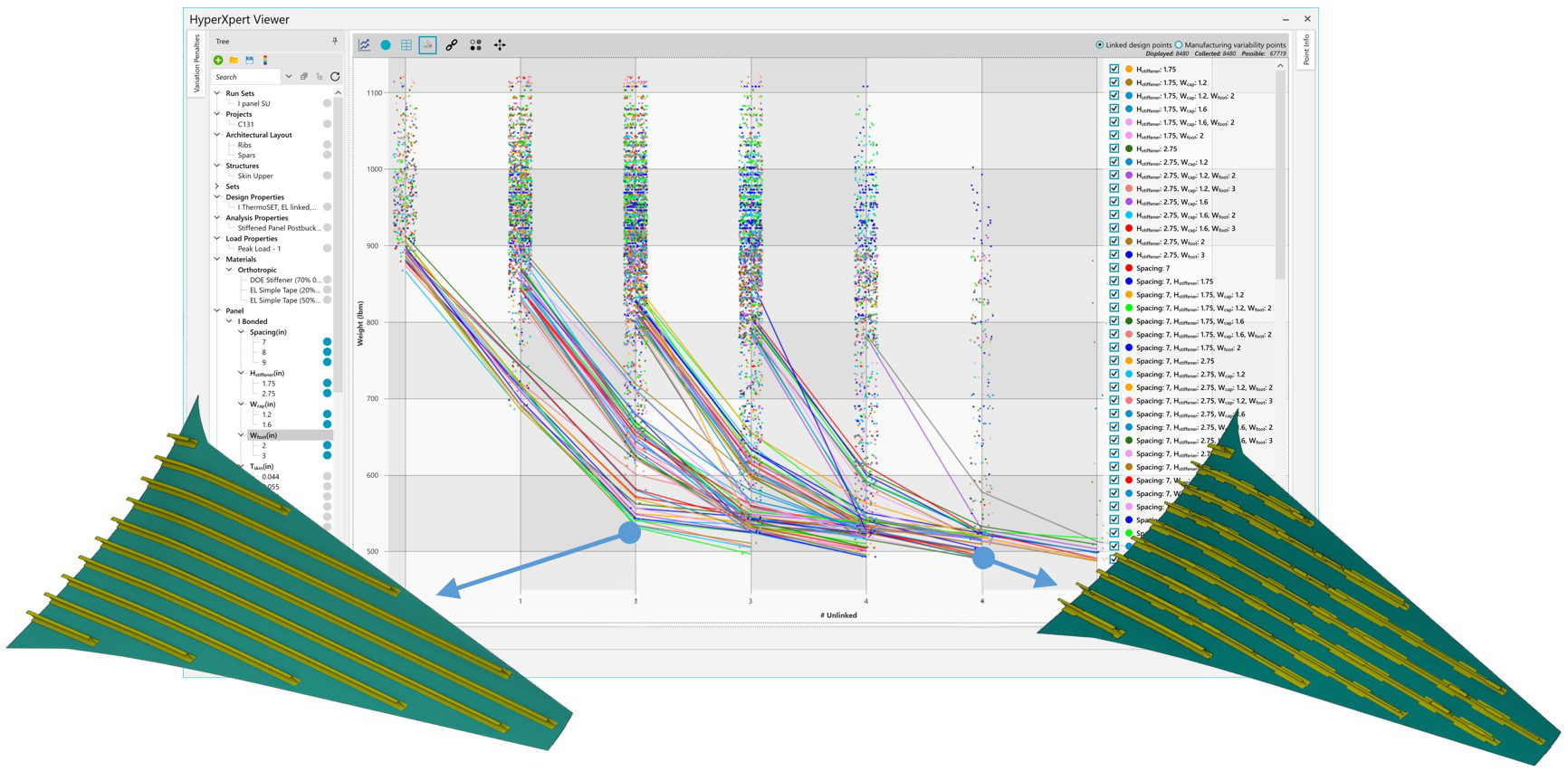
Fig. 1 In the HyperXpert interface, each datapoint represents a single, workable design. Each of the 1000s of workable designs is plotted with respect to weight and relative producibility for quick comparison. The design on the left is slightly heavier but is much more producible than the design on the right due to the common stiffener shape used. CREDIT: Collier Aerospace, 2025 HyperX Users Conference
The idea behind HyperXpert
HyperX uses a structure’s finite element analysis (FEA) results to perform sizing optimization by determining the lightest weight combination of materials and panel cross-sectional dimensions, including layup ply angles and stacking sequences for composite laminates. It establishes a digital thread and works with all major FEA and CAD software, providing the optimum design for all panels, load cases and failure criteria — without having to resubmit the FEA results — and then pushes those results back to the FEM and CAD models.
“HyperX provides the lightest weight solution for a given design challenge,” says Collier, “but not necessarily the most producible.” In the past, reconciling those was typically a very tedious and manual process. “But several years ago, during the Christmas break on a morning when no one else was up yet, I suddenly had an idea. HyperX has the unique capability to not just find a single answer but thousands of optimum solutions in a very computationally efficient way. So, I thought, let’s just let the software keep running, gather all this information and we’ll have this powerful post-process that lets you compare those thousands of solutions. We’ll be able to simultaneously provide producibility insights: If I make all this area the same laminate, how much would it weigh versus having ply drops? And how does the weight vary by stiffener spacing or mandrel height or laminate families?”
Collier imagined an interactive visual tool where engineers can access the data for all designs with positive margins and then plot that to compare weight savings versus producibility. “So, from the thousands of equally lightweight designs, you’re now able to decide which of those is optimum for your company and the way you make parts,” he explains. “When you want the weight as a trend line for stiffener spacing versus mandrel cross-sectional shape, it’s instantaneous. The point is for the engineer to be thinking in real time and not have to wait for the software to complete processing. All the data is precalculated and pre-loaded.”
Hyperxpert at jetzero
With the promise of cutting fuel burn by up to 50%, JetZero’s BWB aircraft offers huge potential but also significant design challenges. “The wing and the fuselage is very much intertwined, a lot more so than in a traditional tube and wing aircraft,” says Thomas. “That means there’s a lot of interaction and discussion between my job analyzing the wing structure and the team doing the analysis for the fuselage.”
His team uses HyperX to do some of that analysis, and Thomas explains how HyperXpert fits in. “For a stringer-stiffened wingskin, we could use hat, T or I-shaped stiffeners, and all of those have different variables. Within HyperX, we assign the min-max bounds for those different variables — e.g., spacing, height, cap width, foot width and for hat stringers, you also set internal angle, which affects your mandrel size and dimensions. HyperX then goes and finds, for all of those different combinations, the lightest-weight solution. However, HyperXpert finds the lightest-weight solution for every combination of those variables that produces positive margins. It’s giving us insight into how those variables interact with each other on the structure.”
“Based on the set of failure criteria assigned in HyperX, combinations of those variables that don’t yield positive margins of safety for every zone across that wingskin won’t return a weight solution in HyperXpert,” he notes, “because they don’t pass all the failure checks. That’s true for any of the combinations of spacing, height, etc, across the entire span of the wing.” This allows the team to focus only on designs that will survive the given loads, and then decide which design best meets the rest of their needs.
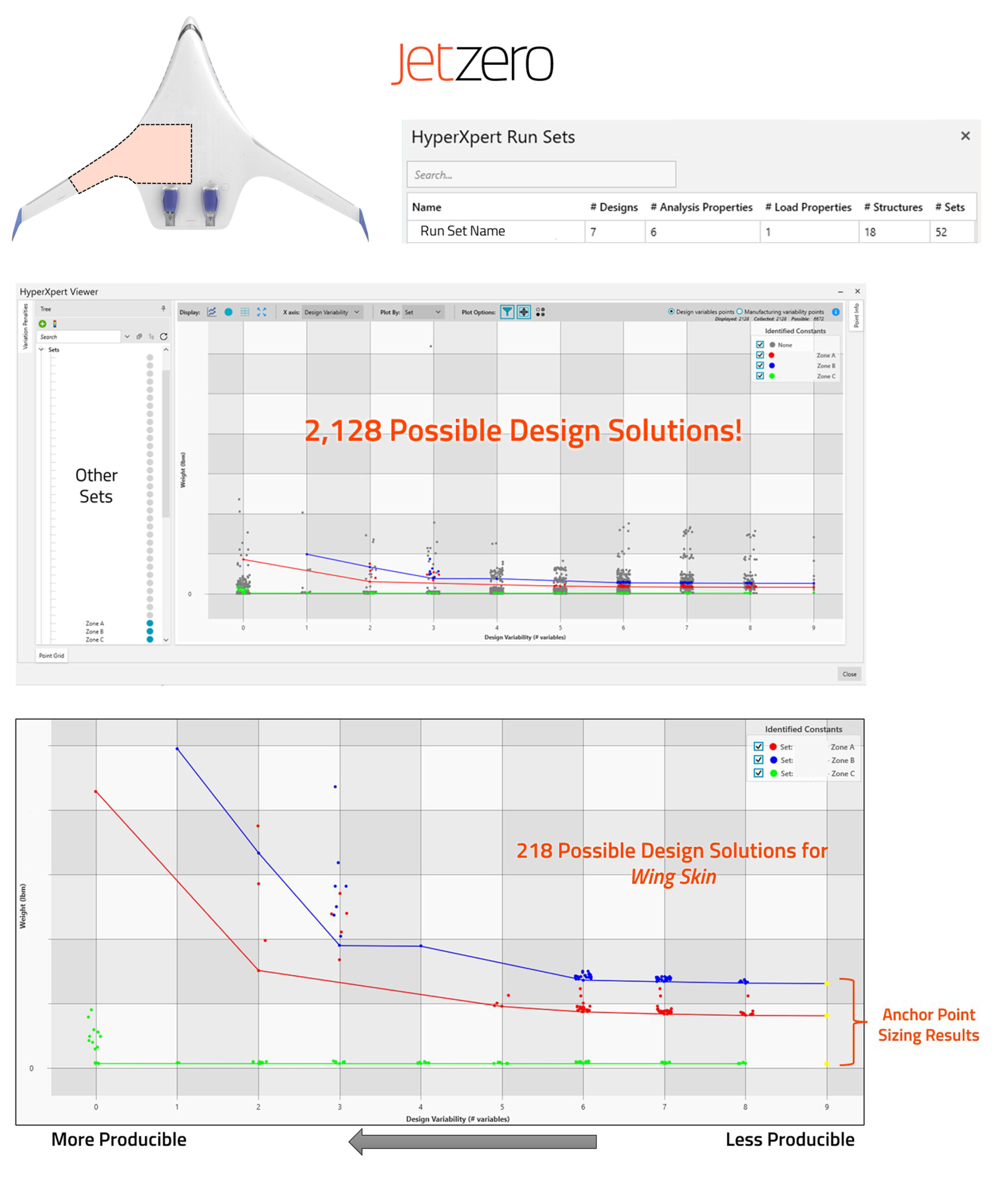
Fig. 2 HyperXpert shows effective laminate producibility results at top and a pareto frontier plot for wingskin sets at bottom. CREDIT: JetZero, 2025 HyperX Users Conference
Full factorial solution without reruns
“When we run HyperXpert, we’re running a full factorial solution across all the variables for a given design property,” says Thomas. Particularly for a wingskin, this is a systematic Design of Experiments (DOE) approach that simulates all possible combinations of design variables and their values to find the optimum design.
“When we go to size a wingskin-stringer structure, for example, that lightest weight solution might involve different stringer spacing as we go outboard on the wing, or different stringer geometry,” says Thomas. “And with HyperXpert, we’re able to look at each of those variables and find the lightest weight solution but then explore producibility. For example, what if we want a more producible stringer shape or a more standardized stringer height? And we’re able to do that all at once. So, it’s running all of that at the same time, so that we don’t have to rerun anything in HyperX.”
He notes that if he had to run a full factorial solution for all of the variables on this type of wingskin structure without HyperXpert, “it would take weeks to get all the same data that HyperXpert provides.”
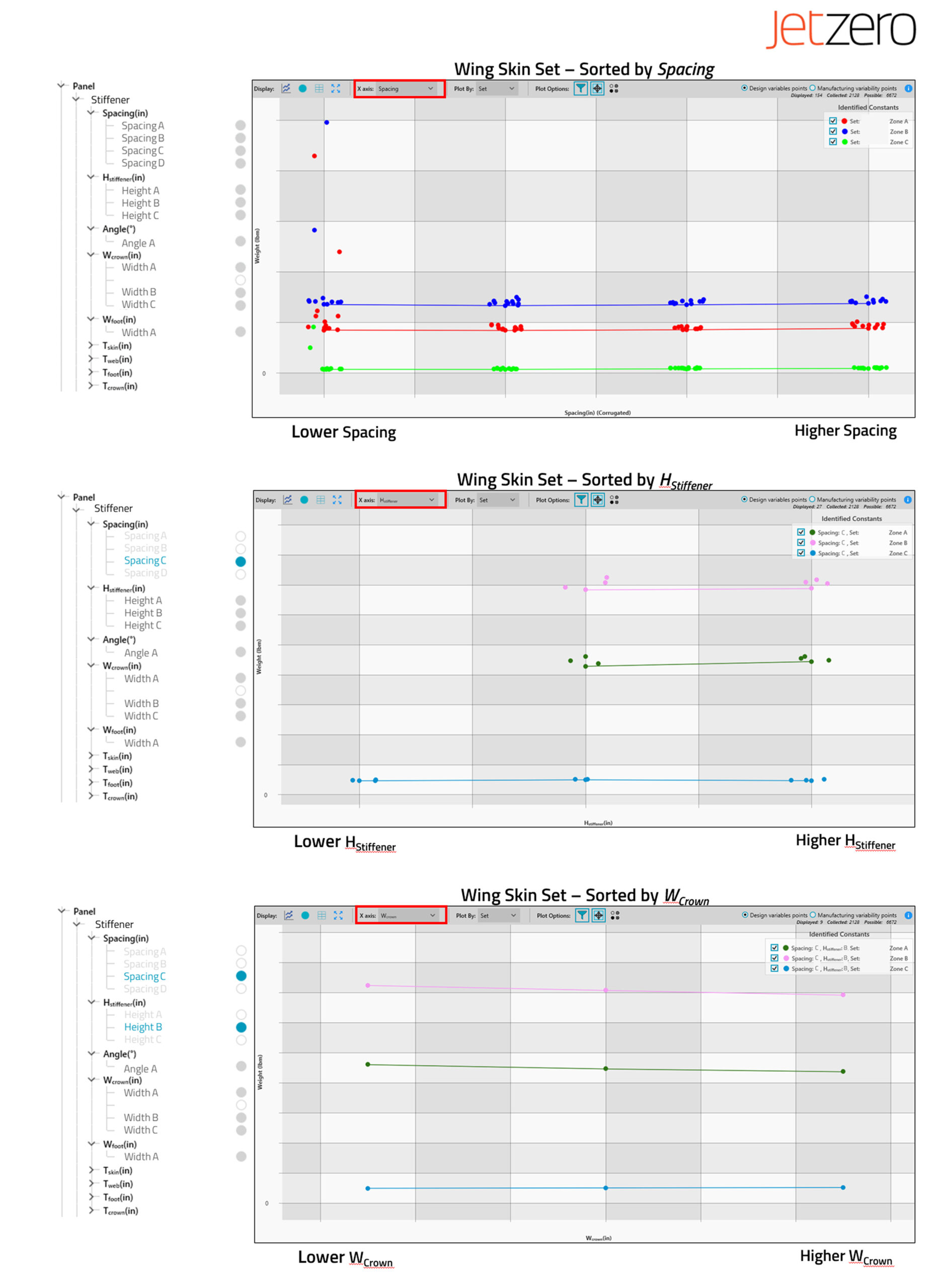
Fig. 3 HyperXpert investigation of wingskin producibility by stiffener spacing, height and crown width. CREDIT: JetZero
Time savings in the design process
The workflow that Thomas’ team at JetZero has adopted has been to first produce an anchor point sizing. In HyperX terminology, the anchor point is the lightest weight solution it provides by default. “This doesn’t consider producibility,” says Thomas, “but it lets us quickly get more realistic internal loads to use. Once we have those, we run HyperXpert, and then after that, we go and pull out all of the different weight values for the different combinations of fixed variables and determine what we want to go with in terms of stringer spacing, height, geometry, etc. It’s kind of the second step in our workflow, and we can then start fixing more of the variables and begin maturing the design further.”
Without HyperXpert, he notes the team would be doing this manually. “Previously, you would have to fix one of those variables yourself and rerun HyperX each time to get the information that we’re talking about. And you would have to do that full factorial yourself, running HyperX multiple times.”
HyperXpert not only saves that work but also eliminates rerunning analysis when changes or quick evaluations are demanded. “Say, we’ve done the initial analysis and have set stringer spacing and geometry and start mocking it up in CAD,” says Thomas, “We then find we need a larger stringer spacing, how will that affect the geometry? With HyperXpert, I don’t have to go and redo the analysis. I just have to go back to the HyperXpert results and look at when we increase our stringer spacing, what is the lightest weight stringer geometry? And then management is going to ask me, ‘when we increase our stringer spacing, what is the weight impact?’ I can give them that number right off the bat, without having to rerun any analysis.”
The fact that, should any changes need to be made down the line, all of the data is there to revisit is one of the more beneficial aspects of HyperXpert, says Thomas. “It’s not just time savings, it’s also the information flow within the whole team and being able to keep the process moving forward.”
HyperX already automates so much of the structural analysis process, says Collier. “The stress engineers are able to respond 30 to 50 times faster than using their typical processes and thus save time on the schedule. But with HyperXpert, this is extended even further. The stress team now has time to look at different possibilities and actually have conversations with the designers to improve the design. And then together, they can make a joint decision about the best way to move forward.”
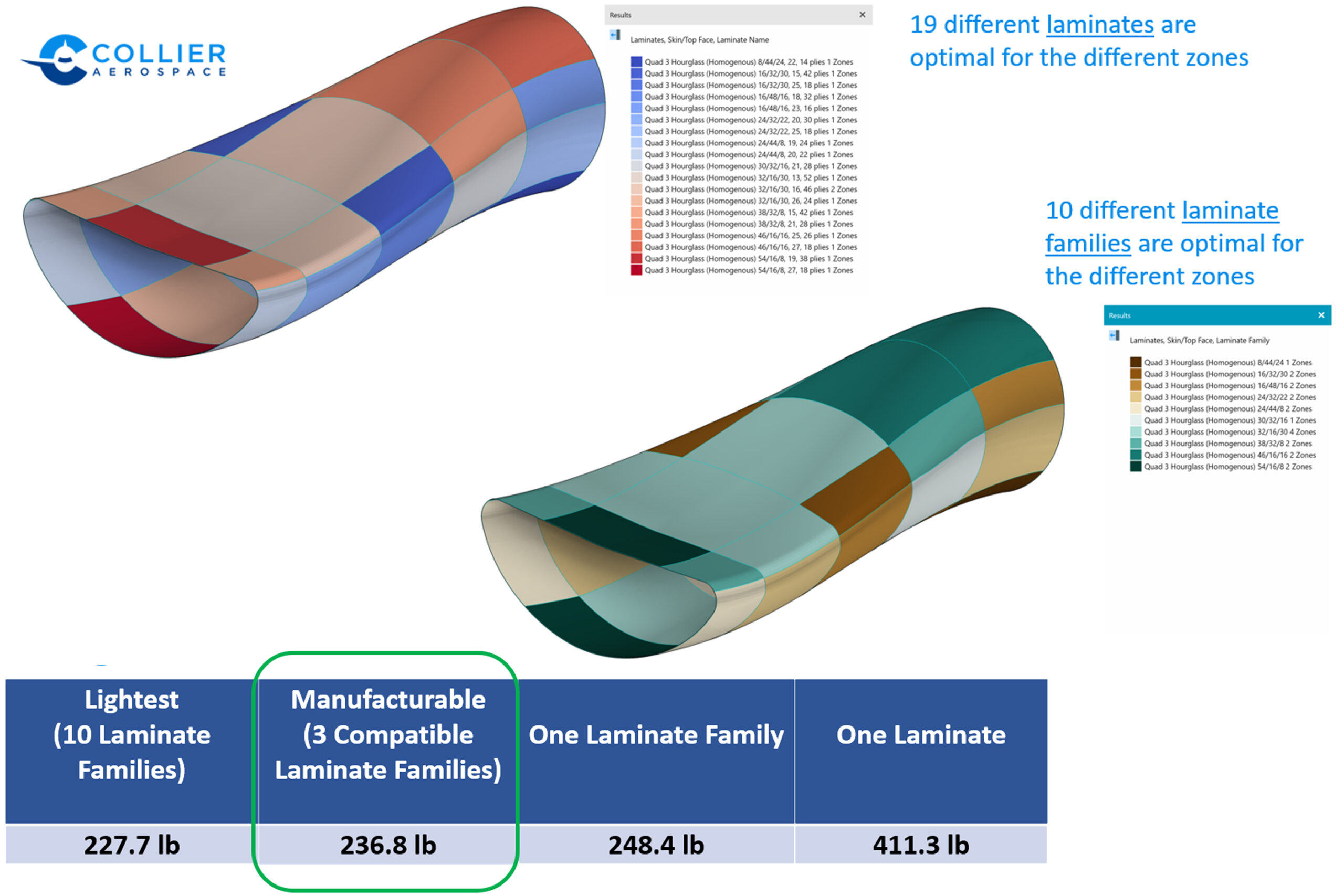
Fig. 4 Optimizing this jet engine air inlet from > 50 laminate families, HyperX found 10 laminate families to be best for different sizing zones. Of those, 19 different laminates were selected for the 19 zones — a unique laminate for each. While 10 different laminate families would not make a manufacturable engine inlet, HyperXpert found 3 laminate families that were compatible to produce a good balance between manufacturability and lightweighting. CREDIT: Collier Aerospace
One example where this can have significant time and cost implications is in composite laminates and testing. Thomas explains how this comes into play with his team at JetZero. “We’ve been using what HyperX calls ‘effective laminates’, which means a homogenized laminate with a given stiffness. But we could also run the analysis with laminate families to understand what the most producible and lightest weight of these would be across a given structure, or a variety of different structures.”
However, he notes, the more laminate families, the more testing is required later on, which adds time and cost. “So, it would be really beneficial for us to know how many different laminate families we really need across the aircraft. What would the weight impact be if we were to use the same laminate family across all of the wing structure? Or say we use the same laminate family from the wing skin also for the spars — that might not be as weight efficient, but it would significantly reduce testing. So, it’s a trade-off of cost and time and weight for the vehicle.”
Having the ability to quickly evaluate those tradeoffs is becoming more and more important as aircraft companies seek to enter the market before their competitors but also make the most of increasingly stretched budgets.
enhancing collaboration
The user interface for HyperXpert is very intuitive, says Thomas. “I also like that you can utilize the data sets within HyperX as well and look at producibility effects across different types of structure. I gave the example previously of different laminate families across the entire wing structure, but you can also break it into zones to analyze what is most producible in each area. For example, if one section of the wing has a different spacing than another, how does that affect the weight? And what happens if those were the same? You can combine those and look at them. Using the sets in HyperX combined with HyperXpert gives you a lot of versatility in understanding your structure.”
There is also versatility in how to use the data from the HyperXpert plots. “In terms of being able to extract the numbers off of a plot, you’re able to actually see what data point you’re talking about when you click on that, which is really helpful,” says Thomas. “You can also pick out different data points on your plot, and HyperXpert will put those into a table at the bottom, giving you the specific information about each. I’ll then export that to Excel which makes it relatively easy to create good tables and charts.”
The dashboard, another tool provided with HyperX, also aids in quick sharing of information. “After I ran this wingskin analysis, my manager said he had a different material system he wanted me to analyze quickly,” says Thomas. “So, I added that system to our database and reran HyperX using the most producible design from HyperXpert and we were able to compare that with previous results. The dashboard updates automatically and I could also just add him to the dashboard, so it makes sharing and reviewing information very quick and easy.”
Instead of a manager looking at a report on their own that is static, they can now interact in the software, looking at and filtering results and exploring the best options. For one of the JetZero analyses, Thomas ended up with roughly 2200 designs. Collier notes that “out of these thousands of data points, the whole team can quickly see how performant the designs are according to the color of those points based on the selected options for different variables.”
He again stresses that HyperXpert was designed to be interactive and used across teams and levels. “Once the data is generated, you don’t have to have HyperX expertise,” says Collier. “You can be in a live meeting and managers or manufacturing personnel who aren’t doing this depth of analysis can still immediately understand the result and the impact of the decisions that need to be made. That’s why the interactivity is so valuable.”
Thus, HyperXpert becomes a data-driven decision tool, the same way that AI is being used. But it also enables collaboration typically not possible. “There really hasn’t been a way to rapidly consider the design and the stress analysis needs at the same time,” says Collier. “So, that’s another key purpose of this tool — to allow the designer, the stress engineer, the manufacturing team and the group evaluating cost to fully explore and evaluate the different ways a structure can be made.”
Dependable, high-quality results
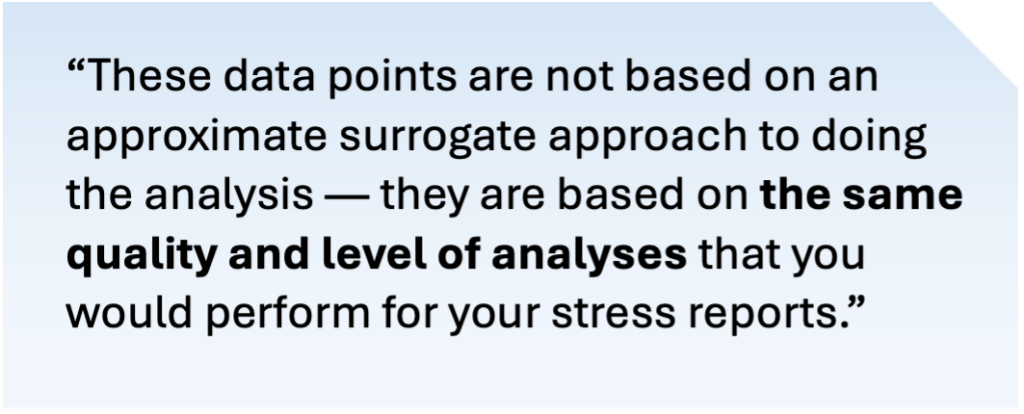
At the end of the day, however, the software has to provide reliable results. “Each of the thousands of data points generated in HyperXpert has an immense amount of validation behind them,” says Collier. “They truly represent a design that is capable of sustaining all the flight loads (or any other prescribed load condition) according to all the rigorous analysis methods required by the FAA — or whoever the customer may be — to show this design has structural integrity. These data points are not based on an approximate surrogate approach to doing the analysis — they are based on the same quality and level of analyses that you would perform for your stress reports.”
Collier Aerospace developed HyperXpert as a tool to help engineering groups accurately quantify weight differences when all the different variables are varied simultaneously. “It allows them to explore all the different tradeoffs and quantify manufacturability considerations early in the design phases,” says Collier. “It enables collaborative, data-based decisions so that companies can avoid unnecessary costs and accelerates the schedule for certification but also for achieving revenue.”
There is always a risk with introducing a new product, he says, “but I thought this would be a useful tool. The feedback we’re getting from users is that we’re filling a void in the industry and providing a capability that is really necessary in aerospace today. I think that’s a great achievement for Collier Aerospace, but even more important is that we’re helping companies develop and introduce revolutionary new airframes successfully.”
WATCH
HyperX Academy: DOE with HyperXpert
2025 HyperX Users Conference: Craig Collier introduces HyperXpert
HyperX® is a registered trademark of Collier Aerospace Corportaion.